Stroke Warning Signs
Introduction
Recognize sudden signs of stroke and understand why immediate action through local emergency services matters.
Learning objectives
- Explain the basic mechanisms of stroke.
- Recognize common sudden neurological warning signs.
- Describe the response to suspected stroke.
- Explain why transient symptoms need urgent evaluation.
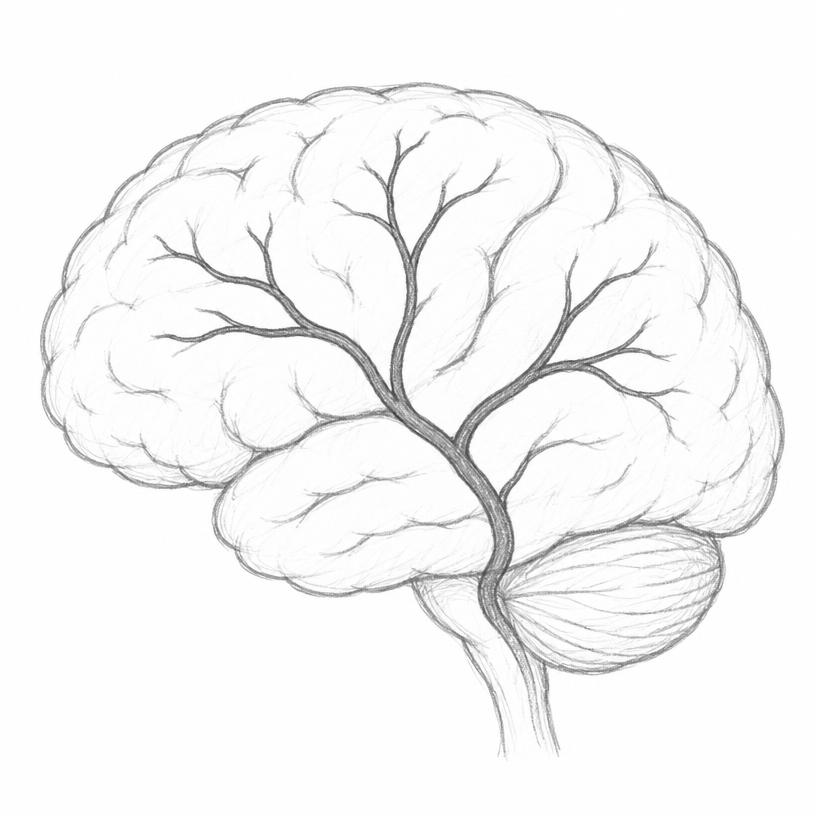
A stroke disrupts blood supply in the brain. Sudden neurological changes require emergency help.
AI-generated schematic illustration; not a clinical image.
Lesson 1
Recognizing sudden neurological changes
What happens during a stroke
A stroke occurs when blood supply to part of the brain is blocked or a blood vessel breaks and bleeds. Brain cells depend on oxygen and nutrients delivered by blood; when that supply is disrupted, injury can begin quickly and may lead to lasting disability or death. Ischemic strokes involve a blocked vessel, while hemorrhagic strokes involve bleeding.
The precise cause cannot be identified reliably by observing someone at home. Because effective care can depend on prompt evaluation, a sudden change in neurological function should not be dismissed or watched for an extended period. Recognizing a possible stroke is enough reason to seek emergency help; diagnosis belongs to medical professionals.
Symptoms that may appear suddenly
Possible warning signs include weakness or numbness, often affecting one side of the body; difficulty speaking or understanding; confusion; vision problems; trouble walking; dizziness; or a loss of balance or coordination. Symptoms can differ between people, and all signs do not have to be present. Focus on whether a change is sudden and unusual for that person rather than trying to complete a checklist.
A new facial, arm, speech, vision, or balance problem deserves urgent attention. Even if the symptom seems mild, uncertainty about its cause is not a reason to delay. Contact local emergency services when stroke is suspected so the person can be assessed promptly.
Lesson 2
Urgent response and transient symptoms
Acting when stroke is suspected
If someone develops sudden signs that could indicate stroke, contact local emergency services immediately. Do not wait for symptoms to improve, and do not delay the call while trying to decide which stroke type might be involved. If possible, note when symptoms began or when the person was last known to be well, and clearly describe what changed.
Keep the focus on getting professional help rather than attempting to diagnose or treat the person yourself. Emergency responders and clinicians can determine what evaluation is needed. This lesson is educational and does not replace instructions from local emergency dispatchers or medical professionals.
Why resolved symptoms still matter
A transient ischemic attack can cause stroke-like symptoms that later disappear. That improvement does not prove the event was harmless: a transient episode may warn of a future stroke and needs urgent professional evaluation. It may not be possible for a person at home to distinguish a transient attack from an ongoing stroke with confidence.
Do not ignore symptoms simply because they lasted briefly or have now stopped. Contact local emergency services or follow urgent professional guidance, and share the timing and nature of the episode. Prompt assessment can help clinicians determine the cause and next steps.
A resolved symptom is still important information, not a reason to postpone care.
Key concepts
- Ischemic stroke
- A stroke caused by a blocked blood vessel.
- Transient ischemic attack
- A brief stroke-like episode that still needs urgent evaluation.
Lessons
Key takeaways
- Stroke can injure brain tissue quickly when blood flow is interrupted or bleeding occurs.
- Sudden weakness, speech difficulty, vision changes, or balance problems can be warning signs.
- Suspected stroke and transient symptoms require immediate professional assessment through local emergency services.
References & sources
Original educational summaries; not a diagnosis or treatment plan. Not independently confirmed by a medical educator.