Cancer Biology and Diagnosis
Cancer begins when normal cell regulation fails.
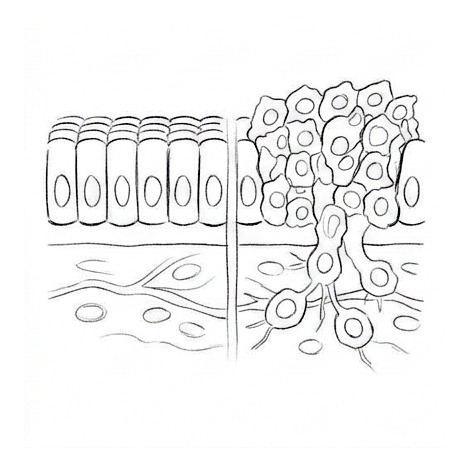
Cancer cells can multiply abnormally and invade surrounding tissue.
AI-generated schematic illustration; not a clinical image.
Understanding the topic
Cancer begins when normal cell regulation fails. Cells may multiply unnecessarily or survive when they should die, producing extra cells that can form tumors. Benign tumors are not cancer; malignant cells can invade nearby tissue and spread elsewhere. Distant spread is called metastasis. The difference concerns biological behavior rather than simply whether a lump exists, and normal replacement of cells is not the same process as uncontrolled malignant growth. A new lump, unexplained bleeding, a nonhealing sore, swallowing difficulty, or a changing mole can warrant assessment. Cancer does not always cause pain. No one test diagnoses every type; history, examination, blood tests, imaging, and other tests may contribute. Biopsy obtains tissue, cells, or fluid for examination. Persistent unexplained symptoms deserve evaluation, but symptoms alone cannot specify the diagnosis or replace examining appropriate evidence. Treatment depends on cancer type and extent.
Lesson 1
Cell regulation and metastasis & Genetic changes are not always inherited
Cell regulation and metastasis
Cancer begins when normal cell regulation fails. Cells may multiply unnecessarily or survive when they should die, producing extra cells that can form tumors. Benign tumors are not cancer; malignant cells can invade nearby tissue and spread elsewhere. Distant spread is called metastasis. The difference concerns biological behavior rather than simply whether a lump exists, and normal replacement of cells is not the same process as uncontrolled malignant growth.
Genetic changes are not always inherited
Cancer includes more than one hundred types and can start in many body sites. Names may identify location or cell type: carcinomas arise from epithelial cells, while sarcomas involve bone or soft tissues. Cancer is genetic because gene changes drive it, but these can develop during life. Only some arise from inherited variants. Calling a disease genetic therefore does not establish that it was passed down by parents.
Lesson 2
Symptoms, imaging, and biopsy & Treatment and risk reduction
Symptoms, imaging, and biopsy
A new lump, unexplained bleeding, a nonhealing sore, swallowing difficulty, or a changing mole can warrant assessment. Cancer does not always cause pain. No one test diagnoses every type; history, examination, blood tests, imaging, and other tests may contribute. Biopsy obtains tissue, cells, or fluid for examination. Persistent unexplained symptoms deserve evaluation, but symptoms alone cannot specify the diagnosis or replace examining appropriate evidence. Treatment depends on cancer type and extent.
Treatment and risk reduction
Treatment depends on cancer type and extent. Options include surgery, radiation, chemotherapy, hormone therapy, immunotherapy, and other approaches, sometimes in combination. Avoiding tobacco, limiting excessive sun and alcohol exposure, activity, and addressing obesity reduce certain risks. Age and inherited susceptibility cannot be fully controlled, so prevention does not eliminate every cancer. Treatment planning and risk reduction involve different questions and neither is a universal guarantee about an individual outcome.
Study guide
- Explain cell regulation and metastasis.
- Explain genetic changes are not always inherited.
- Explain symptoms, imaging, and biopsy.
- Explain treatment and risk reduction.
- Cell regulation and metastasis
- Cancer begins when normal cell regulation fails.
- Genetic changes are not always inherited
- Cancer includes more than one hundred types and can start in many body sites.
- Symptoms, imaging, and biopsy
- A new lump, unexplained bleeding, a nonhealing sore, swallowing difficulty, or a changing mole can warrant assessment.
- Treatment and risk reduction
- Treatment depends on cancer type and extent.
Lessons
Sources
- MedlinePlus en español — Cancer Biology and Diagnosishttps://medlineplus.gov/spanish/cancer.html
Original educational summaries; not a diagnosis or treatment plan. Read by a medical doctor and confirmed reliable, pending formal approval. Sources come from approved websites.