DNA and Genetic Testing
Genetic tests identify changes in DNA, often called variants.
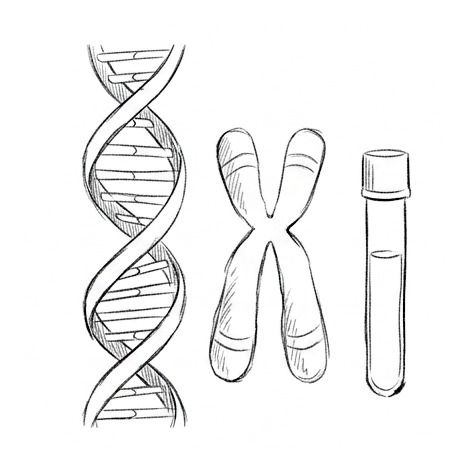
Chromosomes contain DNA. Genetic tests examine DNA for changes that may affect health.
AI-generated schematic illustration; not a clinical image.
Understanding the topic
Genetic tests identify changes in DNA, often called variants. Many genes provide instructions for proteins. Most changes have no effect, but some contribute to disease. Testing can examine genes, chromosomes, or protein amount and activity. Genome sequencing examines all DNA; exome sequencing focuses on regions with protein-making instructions. Chromosomes package DNA with proteins, and people usually have 23 pairs containing hereditary information. Testing can help diagnose disease, identify carrier status, or estimate increased risk. Tests commonly use blood or cheek swabs; other samples may include saliva, skin, or amniotic fluid. A laboratory selects methods to investigate the question. Clinical, research, and direct-to-consumer testing have different contexts. Genetic counselors explain options, limitations, benefits, and results. Interpretation can involve emotional, social, and financial consequences as well as medical information, which makes informed discussion important before and after testing. Increased risk may lead to earlier or more frequent screening, monitoring, or health-behavior changes.
Lesson 1
DNA variants and sequencing & Risk is not a certain prediction
DNA variants and sequencing
Genetic tests identify changes in DNA, often called variants. Many genes provide instructions for proteins. Most changes have no effect, but some contribute to disease. Testing can examine genes, chromosomes, or protein amount and activity. Genome sequencing examines all DNA; exome sequencing focuses on regions with protein-making instructions. Chromosomes package DNA with proteins, and people usually have 23 pairs containing hereditary information. Testing can help diagnose disease, identify carrier status, or estimate increased risk.
Risk is not a certain prediction
Testing can help diagnose disease, identify carrier status, or estimate increased risk. Prenatal tests and newborn screening address different life stages. A result may not predict whether symptoms will appear, their severity, or future progression. Findings may be uncertain or reveal unexpected risks unrelated to the original question. A variant therefore must be interpreted in context rather than treated as a complete forecast of health.
Lesson 2
Samples and genetic counseling & Using results in care decisions
Samples and genetic counseling
Tests commonly use blood or cheek swabs; other samples may include saliva, skin, or amniotic fluid. A laboratory selects methods to investigate the question. Clinical, research, and direct-to-consumer testing have different contexts. Genetic counselors explain options, limitations, benefits, and results. Interpretation can involve emotional, social, and financial consequences as well as medical information, which makes informed discussion important before and after testing. Increased risk may lead to earlier or more frequent screening, monitoring, or health-behavior changes.
Using results in care decisions
Increased risk may lead to earlier or more frequent screening, monitoring, or health-behavior changes. Results can also inform reproductive choices or medicine selection through pharmacogenomic testing. These uses depend on the question, reliability, and meaning of the result. Counseling helps weigh benefits and uncertainty. Testing is not automatically useful for every situation, and an apparently simple result may still require clinical interpretation before changing care.
Study guide
- Explain dna variants and sequencing.
- Explain risk is not a certain prediction.
- Explain samples and genetic counseling.
- Explain using results in care decisions.
- DNA variants and sequencing
- Genetic tests identify changes in DNA, often called variants.
- Risk is not a certain prediction
- Testing can help diagnose disease, identify carrier status, or estimate increased risk.
- Samples and genetic counseling
- Tests commonly use blood or cheek swabs; other samples may include saliva, skin, or amniotic fluid.
- Using results in care decisions
- Increased risk may lead to earlier or more frequent screening, monitoring, or health-behavior changes.
Lessons
Sources
- MedlinePlus en español — DNA and Genetic Testinghttps://medlineplus.gov/spanish/genetictesting.html
Original educational summaries; not a diagnosis or treatment plan. Read by a medical doctor and confirmed reliable, pending formal approval. Sources come from approved websites.