Breast Cancer
The most common cancer in women worldwide: risk factors, detection, and treatment.
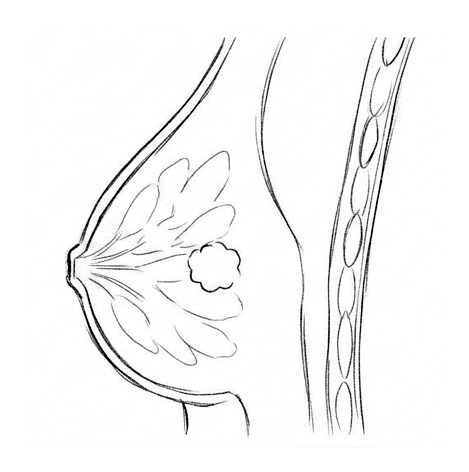
Breast cancer begins with abnormal cell growth in breast tissue and can spread to nearby lymph nodes.
AI-generated schematic illustration; not a clinical image.
Understanding the topic
Breast cancer begins when cells in the breast grow uncontrollably and form a tumor that can often be felt as a lump or seen on an x-ray. Most breast cancers begin in the ducts that carry milk or in the lobules that produce it. Cancer cells can invade nearby tissue and spread, or metastasize, to lymph nodes and distant organs. Although it is far more common in women, men can also develop breast cancer. Risk increases with age, certain inherited gene changes such as BRCA1 and BRCA2, a personal or family history of breast cancer, dense breast tissue, and long exposure to estrogen. Warning signs include a new lump in the breast or armpit, thickening or swelling of part of the breast, skin dimpling, nipple discharge other than milk, and any change in the size or shape of the breast. Many lumps are not cancer, but any new change deserves medical evaluation. Mammography, an x-ray of the breast, can find tumors too small to feel and is the main screening tool. Finding breast cancer early, before it spreads, greatly improves the chance of successful treatment. Ultrasound and MRI provide additional information in certain situations. When a suspicious area is found, a biopsy, the removal of a small tissue sample, is the only way to confirm whether it is cancer and to identify its type. Treatment depends on the type and stage of the cancer and often combines several approaches. Surgery removes the tumor, either the lump alone or the whole breast. Radiation therapy destroys remaining cancer cells in the breast area. Chemotherapy, hormone therapy, and targeted drugs act throughout the body against cancer cells that may have spread. Many people treated for early breast cancer live long, full lives, and follow-up care monitors for recurrence.
Lesson 1
When cells in the breast grow out of control & Risk factors and warning signs
When cells in the breast grow out of control
Breast cancer begins when cells in the breast grow uncontrollably and form a tumor that can often be felt as a lump or seen on an x-ray. Most breast cancers begin in the ducts that carry milk or in the lobules that produce it. Cancer cells can invade nearby tissue and spread, or metastasize, to lymph nodes and distant organs. Although it is far more common in women, men can also develop breast cancer.
Risk factors and warning signs
Risk increases with age, certain inherited gene changes such as BRCA1 and BRCA2, a personal or family history of breast cancer, dense breast tissue, and long exposure to estrogen. Warning signs include a new lump in the breast or armpit, thickening or swelling of part of the breast, skin dimpling, nipple discharge other than milk, and any change in the size or shape of the breast. Many lumps are not cancer, but any new change deserves medical evaluation.
Lesson 2
Early detection saves lives & Treatment is individualized
Early detection saves lives
Mammography, an x-ray of the breast, can find tumors too small to feel and is the main screening tool. Finding breast cancer early, before it spreads, greatly improves the chance of successful treatment. Ultrasound and MRI provide additional information in certain situations. When a suspicious area is found, a biopsy, the removal of a small tissue sample, is the only way to confirm whether it is cancer and to identify its type.
Treatment is individualized
Treatment depends on the type and stage of the cancer and often combines several approaches. Surgery removes the tumor, either the lump alone or the whole breast. Radiation therapy destroys remaining cancer cells in the breast area. Chemotherapy, hormone therapy, and targeted drugs act throughout the body against cancer cells that may have spread. Many people treated for early breast cancer live long, full lives, and follow-up care monitors for recurrence.
Study guide
- Explain when cells in the breast grow out of control.
- Explain risk factors and warning signs.
- Explain early detection saves lives.
- Explain treatment is individualized.
- When cells in the breast grow out of control
- Breast cancer begins when cells in the breast grow uncontrollably and form a tumor that can often be felt as a lump or seen on an x-ray.
- Risk factors and warning signs
- Risk increases with age, certain inherited gene changes such as BRCA1 and BRCA2, a personal or family history of breast cancer, dense breast tissue, and long exposure to estrogen.
- Early detection saves lives
- Mammography, an x-ray of the breast, can find tumors too small to feel and is the main screening tool.
- Treatment is individualized
- Treatment depends on the type and stage of the cancer and often combines several approaches.
Lessons
Sources
- MedlinePlus en español — Breast Cancerhttps://medlineplus.gov/spanish/breastcancer.html
Original educational summaries; not a diagnosis or treatment plan. Read by a medical doctor and confirmed reliable, pending formal approval. Sources come from approved websites.